“This is a fully automated machine translation. The quality and accuracy of machine translation can vary from one text to another and between different language pairs. TRANSFORMIT website admins do not guarantee the accuracy of the translation and accept no liability for possible errors. Please refer to the original text in its original English version if there is any doubt. Some content (such as images, videos, files, HTML links and acronyms) may not be translated or may be inaccurate due to the technical limitations of the system.”
On 1 October 2026, as part of the 2nd TRANSFORMIT Media Study Trip, journalists travelled to Czechia to explore practices of post-disturbance forest management at our Velká Bíteš Satellite Demonstration Areas (SDA). We are happy to share that the trip has already resulted in four reports in Czech media:
This workshop was organised by the European Forest Institute and the Czech University of Life Sciences Prague with the local partner at Velká Bíteš SDA. Three international and five local journalists, including a team from Czech National Television, has joined this trip. Together they walked through forests affected by bark beetle outbreaks and spoke directly with researchers and forest managers. Jiří Nohel, manager of the community forests in Velká Bíteš, guided the group through the day, whereas Miroslav Svoboda and Jan Hofmeister from CZU provided scientific input. The mayor of Velká Bíteš, Ing. Markéta Lavická, also joined the excursion.
More insights from the study trip will follow soon, and we will share further stories as they appear!
What if a forest that looks dead is actually the beginning of something new?
On 1 October 2026, we invite journalists to travel to Czechia to investigate how Europe’s forests are changing — and to question some of the assumptions we have about what a healthy forest should look like. Across Central Europe, forests are being transformed by bark beetle outbreaks, powerful windstorms and prolonged drought. The result can be dramatic: vast areas of damaged or dead trees that appear, at first glance, to be landscapes of destruction.
But the story may be more complicated.
Some disturbed forests are becoming the starting point for new ecosystems. And as climate change alters forests across Europe, researchers and forest managers are reconsidering a fundamental question: Should we intervene — or let nature take its course?
Velká Bíteš site Bark beetle damage in Velká Bíteš site
Get into the forest As part of a study trip at the SDA Velká Bíteš site in Czechia, participants will walk through forests affected by bark beetle outbreaks and see first-hand how different management approaches are shaping the landscape. Some areas have been clear-cut, while others have been left to regenerate naturally. The trip brings journalists directly into conversation with researchers, forest managers and local stakeholders, offering opportunities to ask questions, challenge assumptions and develop potential stories.
Topics will include: • What actually happens to a forest after a major disturbance? • Are bark beetle outbreaks always a sign of forest degradation? • What can naturally regenerating forests tell us about the future? • How is climate change changing the way European forests are managed? • How can journalists explain environmental change when there is no simple story or single solution?
A reporting opportunity — not just a study visit The aim is not to present one definitive answer about how forests should be managed. Instead, the study trip offers an opportunity to encounter competing perspectives, examine the evidence and hear directly from people dealing with these changes on the ground. Journalists will have access to experts, potential interviewees, first-hand reporting experience and story ideas at the intersection of climate change, science and society. The event is organised by the European Forest Institute (EFI) in collaboration with the Czech University of Life Sciences Prague (CZU) and local partners as part of the EFI-coordinated TRANSFORMIT project. Travel funding is available to support participation, including for freelance journalists — we only need a short email why you are interested. Reach out to gesche.schifferdecker[AT]efi.int for more information.
Written by Silvester Boonen, European Forest Institute
In April 15th and 16th 2026, 30 forest practitioners, forest owners, researchers, trainers, and students from 12 European countries gathered in southwest Germany for two intensive days dedicated to one deceptively simple question: How can we better understand the biodiversity potential of forests – in a way that supports real management decisions?
The answer, or at least part of it, was the Index of Biodiversity Potential (IBP), a field-based diagnostic tool that has steadily gained recognition across Europe over the last 15 years. Hosted through the Integrate Network and supported by the HE TRANSFORMIT project, the workshop combined classroom presentations and discussions, insights into the scientific background of the IBP, and extensive field training exercises to prepare future trainers to bring the IBP into their own forestry contexts and institutions.
From the classroom to the forest floor
On the first day, we were welcomed at the town hall of Binzen by Andreas Schuck (EFI) and Frank Krumm (WSL), introducing IBP experts Laurent Larrieu (INRAE, CNPF) and Pauline Marty (CNPF) as our field trainers. Little did we know that the next two days were about to be filled with a tandem of new learnings about the IBP, its theoretical background and a lot of practical knowledge on how to apply the tool in the field.
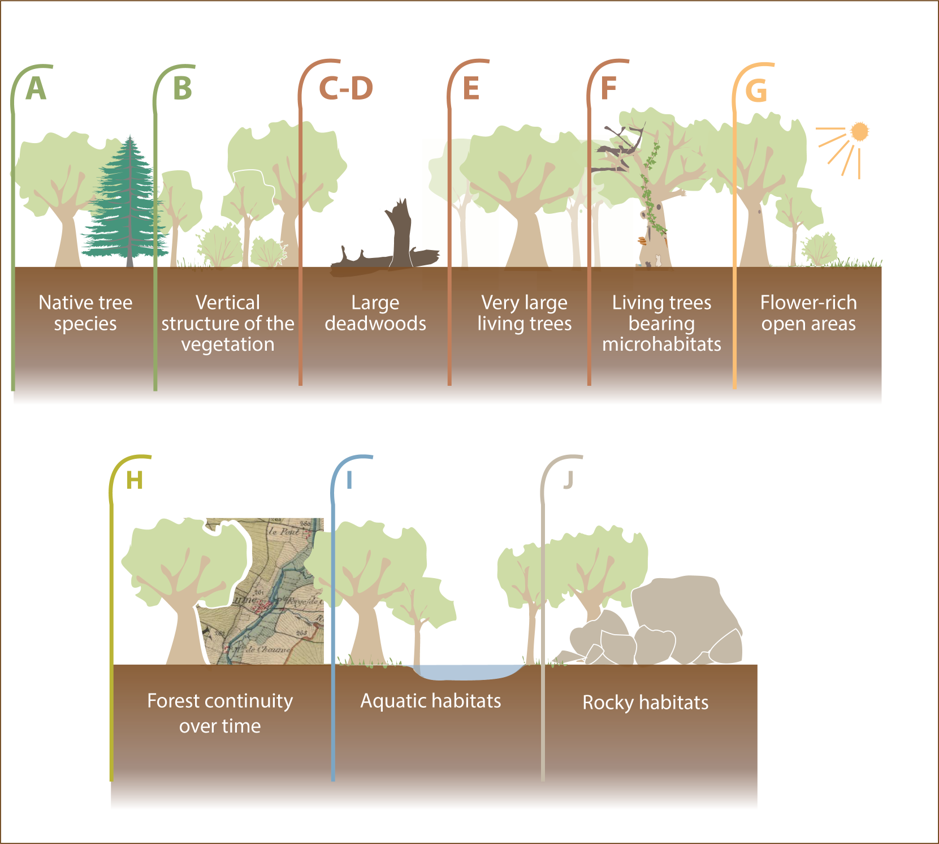
So, what is the IBP? For starters, rather than directly measuring species richness, the IBP evaluates the so-called hosting capacity, habitats and structural features that support biodiversity at the stand level. Pauline explained that the IBP is used as a diagnostic tool, based on ten factors, seven relating to forest management and three to context. These range from deadwood and vertical forest structure to ancient forest continuity and tree-related microhabitats (TreMs). Each factor is scored from 0 to 5, allowing a maximum of 50. The workshop quickly revealed how much ecological research hides behind this easy-to-apply tool. Pauline explained that the IBP is designed to work fast, ideally within 20 to 30 minutes per stand. She then proceeded to go through each IBP factor and why it matters. Let’s take, for instance, the factor for flower-rich open areas: For this factor, the percentage of flower-rich open areas is recorded in comparison to the surveyed area’s size of the stand. As many species not only rely on deadwood, but also the occurrence of flowers, or both, this factor is highly relevant. Some hoverflies species that need deadwood for their larvae and use the nectar from the flowers in the adult stage.
The IBP, a brief overview of the scientific background
Following the introduction of the 10 factors by Pauline, Laurent took over and gave insights into the science behind the IBP. What appears in the field as a quick and practical scoring tool is, in fact, rooted in two decades of ecological research and development. Laurent reflected on the beginnings of the so-called “Paleo-IBP” around 2004, when he and his colleague Pierre Gonin first explored the idea of creating a rapid biodiversity assessment method for forest managers during their routine work. The first version focused on only five factors – large snags, large logs, very large trees and trees bearing “defects”, large nests, and aquatic habitats. This work eventually led to the landmark 2008 publication introducing the IBP as a “quick and easy method” that did not require taxonomic expertise. Laurent explained how the following years saw continuously refining and validating of the tool. Research explored whether the factors complemented each other, how sensitive the scores were to different forest types and management intensities, and how certain ecological components – especially tree-related microhabitats, deadwood, and forest continuity –could be better understood scientifically. Further, the IBP was adapted to different biogeographic regions (e.g. temperate Europe and the Mediterranean Basin). This process is still ongoing as new regions plan to apply the IBP. Despite all this scientific depth, Laurent stressed that the strength of the IBP remains its practicality: a fast, accessible field tool!
“TreMs are way nicer!”
After all this, it was time to head to the field! We drove to a local communal forest, which Frank introduced to us. The stands consist mainly of high-quality oak with an understory of hornbeam. “They serve the needs of the community as a financial reserve, for example, to renovate a school”, Frank explained.
It was then time to investigate the diverse IBP factors hands-on! Spring was in full swing as the trees had their fresh green leaves, and the ground was covered with spring flora. To start off, Pauline introduced the five layers of the factor, also called ‘vertical structure’ (e.g. 1.5-7 m being the third layer). Here, a layer counts when you can observe a 20% occupancy of leaves in that layer. Important to note is that spring flowers on the forest floor would not be counted as an area for flower-rich open areas, as this factor looks at flowering plants linked to gap dynamics, open areas, and forest edges.
Laurent advised to ‘eliminate’ individual factors as quickly as possible. This means that once the threshold of a factor is reached (e.g. 5 different tree genera), one can neglect that factor, as the maximum score of 5 points is reached. This speeds up the process of filling out the survey and allows forest practitioners to concentrate on the factors which are more difficult to record.
Laurent also noted that an “IBP is a score for today, but one should keep in mind that forests are dynamic and scores can change over time!”
We stopped at a large oak tree. Laurent turns to the group and says: “So, flowers are nice, deadwood is nice, but TreMs are way nicer! I wish TreMs could be higher than 5 in the score, but my colleague Pierre said no, all the factors need to capped at 5”. Everyone laughed! Laurent showed us why he likes this tree, pointing at the loose bark. “This is a bark shelter. It’s loose hanging bark that can serve as a shelter along the trunk with an opening at the bottom; an important feature, e.g. for bats or birds. We then took a look inside and, “voilà”, we could see a nest! Pauline then presented us with a special case, where we saw a combination of both a deadwood log and a snag. While the tree broke down, the lower stem (snag) was still attached to the upper stem that became a log. Such a tree can thus be counted as both lying and standing deadwood.
When we walked further, we came across an atypical kind of pond, a skidding trail, with an aquatic habitat that hosts different species. While this sounds great for biodiversity, skidding trails are caused by harvesting machinery, thus damaging the soil of the forest. This is one of the main reasons why, according to the IBP framework, it is not counted as an ‘aquatic habitat’ and therefore not recorded within the survey. This was the final stop before wrapping up our walk, now having a much better understanding of each IBP factor and ready to soon put the knowledge into practice the next day.
As a final stop we partook in a guided tour through Frank’s farm in Binzen, learned about the local wine culture, and got a small taste of the wine and liquor he makes from his own grapes and cultivated fruit trees.
Walking a plotline
On the second day, we headed out to the Kandern Community Forest, which is part of the foothills of the Black Forest. We met at the natural monument “Beheleneiche”, an old oak tree that has an estimated age of more than 300 years. It only died and fell over around a year ago. Its tree trunk remains, as lying deadwood, offering food and habitat for many organisms – a haven for biodiversity!
So, what was waiting for us that day? With the hope of putting our newly acquired knowledge into action and completing an IBP survey, we divided into small groups. Not sure where to start, Pauline and Laurent helped us by introducing diverse inventory approaches, including 3 possible methods: a route in a) concentric circles, b) a star shape or c) parallel lines. Each group got to pick one method, with our group choosing the concentric circle one.
We then started our survey in the Behleneiche marteloscope, named after the monumental oak tree. To save time, we learned to check the factors as much as possible from one location, as some required much more discussion or detailed observations. Native tree genera were an easy exercise: we spotted beech, maple, oak, wild cherry, and pine… check, 5 points! We then marked the broken tree as a snag, but … wait … another participant noticed that the tree was still alive! Still important for the IBP survey, as it may bear microhabitats. We then were able to count some medium-sized logs as lying deadwood. We also used a TreMs field guide and identified a split fork in a wild cherry.
After the inventory of the inner circle we went on to survey the circular route. We paid particular attention to the factor of ‘vertical structure’, while identifying a few very large trees that were checked for additional TreMs. We then wrapped up our survey : 5 points for native tree species, standing deadwood, living trees bearing microhabitats, very large trees, 2 points for large lying deadwood and vertical structure. The factors with no score were flower-rich open areas, forest continuity, aquatic and rocky habitats, as there were simply none present.
We then started to gather at the Behleneiche, to exchange on what we had surveyed. The local forester, Otto-Jesko von Schröder, joined and shared some insights on the Kandern Community Forest and its management. He highlighted the aim of ensuring a large number of different tree species in stands, emphasising those that can best cope with climate change impacts. One important detail we learned from Otto-Jesko was that formerly these sites were used for mining, which means that in the past, parts of these forests were cleared. For the IBP score this means 0 points for forest continuity over time.
Back in the classroom, the final afternoon sessions gave participants the opportunity to reflect on the IBP survey and place them into a broader operational context, learning about special cases (e.g., the uncapped version of the IBP). They also offered a glimpse into the future development of the IBP, including digital tools and applications designed to support field inventories and data collection more efficiently. By the end of the workshop, the IBP no longer felt like a simple scoring system, but rather like a practical framework that truly connects ecological understanding. Quite a few participants already announced that they will initiate training events in their home countries. Thus, it seems, the mission of training “future” trainers was already accomplished in Binzen! In any case, a memorable workshop for all – one that will hopefully continue to bear its fruits in many forests across Europe.
“Indicators should be implementable, measurable, and aligned with other standards so they can ultimately support forest restoration and Integrative Forest Management across Europe,” said Gesche Schifferdecker as she wrapped up the webinar.
Co-organized with the Integrate Network, our webinar “From Indicators to Action – Bridging Science, Policy and Practice in Forest Restoration and Integrative Forest Management” brought together more than 90 participants from research, policy, and practice to explore how forest indicators can help ambitious restoration policies, particularly the EU Nature Restoration Regulation (NRR), to be effectively translated into action on the ground.
After Gergely Zagyvai, Integrate Network Chair 2026, opened the session with a welcome address, Stefanie Linser (University of Natural Resources and Life Sciences, Vienna (BOKU)) delivered a keynote presentation on the development of Integrative Forest Management indicators within the TRANSFORMIT project.
This was followed by a rich panel discussion, moderated by Gesche Schifferdecker, featuring José I. Barredo (JRC – European Commission), Bernhard Wolfslehner (European Forest Institute), Teresa Baiges Zapater (Centre De La Propietat Forestal), and Stefanie Linser (BOKU). Together, they explored how diverse forest-related indicators can support decision-making across different governance levels, the practical challenges of monitoring and reporting, and ways to bridge the gap between policy ambitions and practical implementation.
The panel ultimately agreed on one objective: we have to support our forests to become more resilient – and this can only be done if scientists, policy makers, practitioners, and communication experts work collaboratively.
Many thanks to our outstanding moderator, speakers and panelists, and to everyone who joined, asked questions, and shared their experiences!
The recent “Train the Trainers” event in Binzen, Germany, jointly organised by TRANSFORMIT project and the Integrate Network, and attended by Jonathan Spazzi (Teagasc) and Dermot Dunphy (DAFM), was instrumental to further bring the IBP survey methodology front and centre as part of the Irish Marteloscope workshops. As fully booked events, these workshop series showcase the current interest in Ireland to learn more about the integration of biodiversity conservation into management practices and, in particular, the Index on Biodiversity Potential. Here a blend of forest owners, practitioners and students are coming together to take part in frank and meaningful discussions.
So far, the feedback received is excellent, says Irish Integrate Network member representative Jonathan Spazzi. The organizers expect around 80 participants to be trained this spring with more planned to attend trainings in Autumn.
Through the Integrate Network and a range of research and development projects, including SimInForest and the TRANSFORMIT project, collaboration across Europe between educators and researchers is ongoing on how best to best promote and communicate new, integrative, and closer-to-nature management solutions and ensure that forest health and productivity can continue to provide essential services to society’s collective well-being.
Forests and their management are undergoing rapid transformation driven by climate change, shifting ecosystems, and evolving societal expectations. This session at the International Forest Policy Meeting (IFPM6) in Prague explores how forestry education must adapt to prepare future professionals and scientists for this complexity and uncertainty. The session is hosted by Andreea Spinu on behalf of TRANSFORMIT.
Bringing together educators, researchers, and student representatives, the session examines how curricula can be reimagined to better align with emerging competencies, labor market demands, and diverse career pathways in the forest sector. Drawing on current research and international perspectives, we will discuss innovative approaches to teaching, identify key skill gaps, and reflect on how to strengthen the link between education, research, policy, and practice.
The session combines short presentations with an interactive World Café, fostering exchange on future jobs in the green sector, essential competencies, inclusion and diversity in forestry education, and the role of academic institutions in shaping future-oriented learning.
An upcoming 2-day field workshop on the “Index of Biodiversity Potential”, short IBP, with Laurent Larrieu (INRAE/CNPF) and Pauline Marty (CNPF-IDF).
In collaboration with the Integrate Network, the EU-Horizon TRANSFORMIT project is organising a 2-day field workshop on the “Index of Biodiversity Potential”, short IBP. It will take place from 15th to 16th of April 2026 in Binzen and Kandern, Germany located near the city of Basel (Switzerland).
The idea for a “train the trainers” workshop emerged at the Integrate Network Annual Meeting held in October 2025 in Ireland, where the IBP was introduced by Laurent Larrieu and Pierre Gonin (INRAE/CNPF). Interest arose from participants to organise a training event in the near future on how to apply the IBP. As the IBP was instrumentally developed by Laurent and Pierre over the past decades, we would like to take the opportunity to have the training with Laurent who is retiring in the course of 2026 (Pierre will already retire in March this year).
What is the IBP and how can it be applied?
The IBP is a simple diagnostic tool designed to help forest managers practise biodiversity-friendly forest management. The index is based on a rapid assessment of ten features (or key factors) that influence the capacity of forest stands to support animal, plant, and fungal species. These 10 key factors consider the most common structural drivers of forest biodiversity and include native tree species, vertical structure of vegetation, standing and lying deadwood, large living trees, living trees bearing microhabitats, flower-rich open areas and three factors related to site history and site conditions. The key factors can be quite easily recorded in the field using a well-designed protocol by Laurent and Pierre. For recording no additional equipment or special taxonomic expertise is required to assess the IBP score. The application of the IBP has great potential, e.g. for forest/nature conservation managers, forest owners, consultants, forest training centres, educational institutions in practical work or education. The index can also be used by science as a rapid stand description protocol for example to analyse biodiversity patterns for example in different types of managed forest and such not being managed.
This workshop will provide theoretical insights to the IBP, the science behind it, and its application in the field. Further the participants will be introduced to good practices to implement training events at their own enterprises, institutions, or administrations. You will also have the chance learn more about both the Integrate Network and TRANSFORMIT project, as well as meet new people working in the field of integrative forest management and forest biodiversity.
Join us for a 1.5–2-hour interactive webinar that brings together scientists, policymakers, practitioners, and civil society to explore how knowledge on forests and biodiversity can be better connected, communicated, and put into action. Rather than a series of presentations, this event will emphasize open dialogue and active engagement among all participants.
We’ll kick off with short, insightful inputs from our diverse panelists – representatives from science, policy, practice, indigenous communities, and NGOs – who will share how they prepare and exchange knowledge in their work.
A lively panel discussion will then dive into key questions:
How can scientific, practical, indigenous, and policy knowledge be made more accessible and actionable?
How can we bridge these different knowledge systems to strengthen biodiversity conservation and sustainable forest management in a changing climate?
Participants are warmly invited to join the conversation before and during the event via this Padlet board – submit your questions, share your experiences, and help shape the discussion.
The webinar will also spotlight where to find reliable and tailored knowledge on forest management and biodiversity under climate change, including an introduction to the newly launched Forest Knowledge Gateway.
The panel session, moderated by Jo O’Hara, aims to strengthen knowledge exchange networks and inspire more inclusive, effective collaboration across forest-related communities.
Join us for a 1.5–2-hour interactive webinar that brings together scientists, policymakers, practitioners, and civil society to explore how knowledge on forests and biodiversity can be better connected, communicated, and put into action. Rather than a series of presentations, this event will emphasize open dialogue and active engagement among all participants.We’ll kick off with short, insightful inputs from our diverse panelists – representatives from science, policy, practice, indigenous communities, and NGOs – who will share how they prepare and exchange knowledge in their work.A lively panel discussion will then dive into key questions:
How can scientific, practical, indigenous, and policy knowledge be made more accessible and actionable?
How can we bridge these different knowledge systems to strengthen biodiversity conservation and sustainable forest management in a changing climate?
Participants are warmly invited to join the conversation before and during the event via this Padlet board – submit your questions, share your experiences, and help shape the discussion.The webinar will also spotlight where to find reliable and tailored knowledge on forest management and biodiversity under climate change, including an introduction to the newly launched Forest Knowledge Gateway.
The panel session, moderated by Jo O’Hara, aims to strengthen knowledge exchange networks and inspire more inclusive, effective collaboration across forest-related communities.
In early October, the Integrate Network representatives gathered in Dublin, Ireland, for their annual meeting – a few autumn days brought together forest owners, researchers, policymakers, and practitioners from across Europe. They came with a shared mission: to learn from each other’s successes and challenges in Integrative Forest Management (IFM) practices.
Among the many productive sessions and exchanges, one captured the collaborative spirit of the gathering – an interactive World Café. This participatory method invites people to rotate between small discussion tables, sharing perspectives and building on one another’s ideas as they go. It turns a meeting into a living dialogue, where every voice adds a piece to the bigger picture.
We had five tables, three questions, and one goal: to reflect together on why IFM is needed, what barriers stand in the way of its wider adoption, and how collaboration can help drive progress.
Why – The roots of resilience
When the first question was asked – Why do we apply integrative forest management? – the answer came as a series of insights that rooted back to one word: resilience.
Participants spoke of forests that must endure uncertainty – storms, pests, changing climates, and shifting societal expectations. To strengthen resilience, they agreed, is to ensure that forests can provide multiple goods and services – timber, biodiversity, recreation, clean water – without losing their vitality.
One participant captured it simply: “It’s about balancing production with diversity and all the other ecosystem services society depends on.” Another added that IFM is “a means of compromise” – between societal interests, biodiversity conservation, and the needs of forest owners.
Stories emerged from practice too. A forest owner had started planting oak, “just to do something different,” his peers recounted. This small spark of curiosity became a symbol of innovation – a forest that is more diverse and resilient. It showed how change often begins quietly, with one decision that ripples outward.
And as others noted, IFM is also an act of education: “It’s not just on paper. Everybody can see how it looks outside in the forest.”
Credits: Rahel KönenCredits: Rahel Könen
What – Between vision and reality
As the conversation turned to practice, the tone grew more grounded. Implementing IFM, the groups agreed, is demanding, held back by limited training, a shortage of skilled contractors, and insufficient financial incentives. The forestry systems in many countries are still “set up for big machines,” which makes closer-to-nature approaches harder to apply. Some raised issues like deer pressure, fragmented ownership, or the need to better adapt IFM to regional contexts where conditions and traditions differ.
“Integrative forest management is more complex to manage,” as the conversation went. “There are more things you have to take into account – and for that reason it’s more costly.”
Yet behind each challenge lies persistence. In smaller forests where hiring a professional was unaffordable, owners learned by doing, guided by peer exchange and shared experience. Participants also discussed the importance of valuing the benefits of IFM – not just timber, but carbon, water, biodiversity, and the social value of healthy forests.
How – Growing together
The final question – How can we collaborate better? – explored the potential of working side by side to support a widespread adoption of IFM.
Forest demonstrations and peer learning were seen as powerful catalysts for change. “If one forest owner plants differently, a neighbour might follow. It takes one person to break the ice,” as one reflection captured.
The conversation grew into a reflection on networks – the need for “champions” who inspire others, and for meetings that bring people together not just professionally, but as a community. Collaboration, participants noted, requires translation – not just between countries and professions, but also for society. “Foresters talk to each other in the same language,” one participant observed. “But society needs to understand us too so that we can show improvements and gain acceptance.”
Inclusion was another key theme: being mindful of local customs, power dynamics, and the ways policies align across EU and national levels. The discussion closed with a clear takeaway: investing in collaboration and education today builds resilience and understanding for tomorrow, avoiding the higher costs of restoration later.
A living conversation
The World Café in Dublin ended with a sense of shared direction. “Why Integrative Forest Management?” one participant reflected aloud. “Because we can. Because it’s possible – and our skills keep growing. We can do it, and that’s exactly why we do it.”
This message lingered in the room long after the discussions ended – as an affirmation of what unites the Integrate Network: the belief that forests, like communities, grow stronger through diversity, dialogue, and care.
And in that shared space – between the forest and the meeting room, between policy and practice – something continued to grow: understanding, trust, and the quiet confidence that IFM remains a living practice, strengthened by dialogue, tested by challenges, and carried forward together.