“This is a fully automated machine translation. The quality and accuracy of machine translation can vary from one text to another and between different language pairs. TRANSFORMIT website admins do not guarantee the accuracy of the translation and accept no liability for possible errors. Please refer to the original text in its original English version if there is any doubt. Some content (such as images, videos, files, HTML links and acronyms) may not be translated or may be inaccurate due to the technical limitations of the system.”
This approach is called Integrative Forest Management (IFM), which means looking after forests in a way that balances wood production, nature protection, biodiversity (the variety of plant and animal life), and climate goals.
The team has now completed a major report for the European Commission. This report shows how remote sensing – the use of drones, satellites, and other tools to collect data from a distance – can be used to support IFM. With the report done, the researchers will now focus on creating new tools that can help local forest projects (called Living Labs) and forest enterprises to better protect and increase biodiversity when planning their forestry work.
Curious to know more?
Here are some key findings from the report and data analysis:
Airborne laser scanning helps to monitor the forest structure Using a technology called LiDAR (a laser system mounted on an airplane or drone), scientists can scan the forest and create a detailed 3D map of its structure. This shows how trees are spaced, how tall they are, and how complex the forest layers are. In many cases, only a small amount of extra information was needed to understand the forest well enough for planning.
Aerial images could help to identify tree types and deadwood Although they didn’t have many high-quality aerial images (photos taken from planes), the researchers reviewed other studies that show how these images – especially when combined with spectral sensors (tools that detect different wavelengths of light, even ones the human eye can’t see) – can be used to identify different types of trees and detect dead wood, which is important for many forest species.
Satellite images can monitor forest changes over time By looking at satellite images taken over several years (called time-series), the researchers could detect signs of damage or disturbance in forests – such as storms and wildfires. This information helps in spotting potential risks early and improving forest management. This part of the study was done closely with FGI in Finland.
Ground-based laser scans build 3D forest models On the ground, researchers used high-resolution terrestrial laser scans (a laser scanner set up inside the forest) to create highly detailed 3-D models of the forest. These models are incredibly useful as they let researchers study individual trees in great detail and can improve estimates of forest biomass in natural forests, as well as identify individual trees that are important for biodiversity.
What’s next?
The SLU team will now dive deeper into these indicators of biodiversity and focus on using these remote sensing tools to better measure biodiversity within forests. One big goal is to help countries develop their national plans to restore damaged ecosystems – something required under a new European law called the Nature Restoration Regulation (NRR).
In collaboration with LUKE, they will both compare and contrast the use of Decision Support Systems (DSS) – software systems that include tools to help forest managers make better choices – across Finland and Sweden. New remote sensing methods will then be developed, specifically designed to support and improve forest planning for biodiversity.
Article written by Jacob Parry from the Swedish University of Agricultural Sciences (SLU)
New collaborative project launches to integrate societal demands with biodiversity conservation
Whether we witness branches coming back to life as spring unfolds, observe squirrels swiftly disappearing into the woods, or notice the crisp sound of boots on snow-covered trails—forest experiences hold meaning to us in many ways. But how else can we value forests?
Clean water sources, fresh air, healthy soil, flood control, climate change mitigation, and the survival of wildlife—all of these contribute to the relational value of forests. This goes beyond mere timber; forests embody a wealth of long-lasting socio-ecological benefits. We deeply rely on forests for social, economic, and cultural wellbeing. Balancing the needs of diverse stakeholders and reconciling short-term gains with long-term interests has been a historical challenge in the relationship between societal demands and forest conservation efforts. It is a dilemma that risks fueling environmental conflict and pessimism across the world.
Integrative Forest Management (IFM) emerges as a practical solution to address these conflicts. IFM seeks to harmonize the ecological and socio-economic demands for forests through sustainable forest management, aiming to enhance biodiversity while equally ensuring economic viability. Over the past 13 years, European Forest Institute’s (EFI) exploration and research into IFM through projects like Integrate (2011-2013), Integrate+(2013-2016),INFORMA (2017-2020), and FoReSite (2020-2022), have been proactive. While the concept of IFM is well-established, it currently lacks operational elements in terms of verification, monitoring, guidance, and Europe-wide implementation. This gap is what led us to initiate the new TRANSFORMIT project.
TRANSFORMIT is a large project that is so much on the pulse of time, because it tackles the question of biodiversity-friendly forest management not only from a theoretical point of view but responds to concrete political and practical needs for guidance.”
Bernhard Wolfslehner, TRANSFORMIT Project Coordinator
Building bridges across stakeholders, disciplines, and regions
TRANSFORMIT aims to actively build bridges between practical and scientific knowledge, encouraging collaboration and mutual learning amongst scientists, policy makers and practitioners across Europe and beyond. It is through this collaborative spirit that the project focuses on improving and showcasing the effectiveness of IFM as a viable pathway for integrating multiple, and sometimes opposing, demands to forests. As such, TRANSFORMIT stands for “Transforming Forest Management for multiple ecosystem services and nature conservation via the Integrative approach”.
TRANSFORMIT project logo
Based on knowledge gained from collaborating with diverse institutions and experts in science, policy and practice, the main objective of TRANSFORMIT is to launch an IFM Knowledge Hub, a Stakeholder Engagement Platform, as well as support practically informed policy implementations that could guide the future direction of sustainable forest management in Europe. And, as project coordinator Bernhard Wolfslehner emphasizes, “since biodiversity is one of the prevalent topics on the political agenda, this demonstration and cooperation aspect is crucial for a dynamic implementation of sustainable forest management in a changing environment.”
This also holds relevance for wider sustainability visions and goals. With a clear focus on forest-related policies, the European Green Deal places a renewed emphasis on forests as the center stage for achieving desired sustainability outcomes – forests are seen as an important renewable resource that can support transitioning to a more circular bioeconomy, while also holding irreplaceable value for storing carbon and protecting biodiversity.
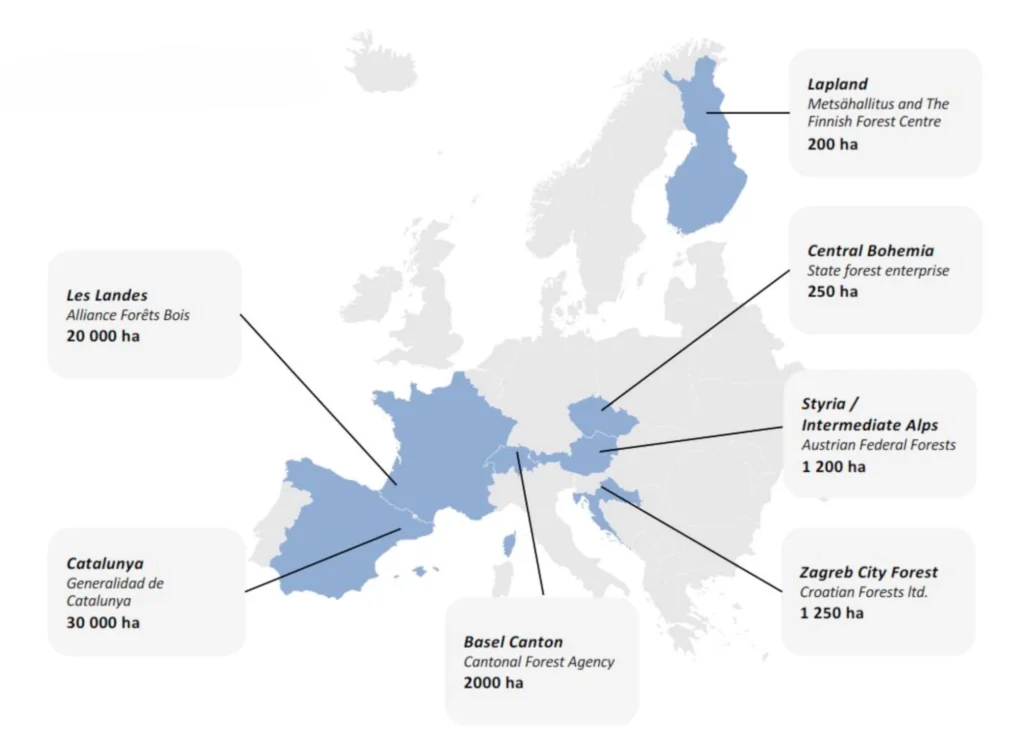
TRANSFORMIT’s innovative approach to IFM is exemplified through its seven Living Labs, which are real-life forest spaces that showcase IFM in action across Europe. These Living Labs, carefully selected to cover different cases and challenges related to IFM, will be a fundamental layer of TRANSFORMIT.
Overview of the seven Living Labs
The significance of the Living Labs will extend beyond mere experimentation. They will also serve as catalysts for knowledge exchange, capacity building, and collaboration among forest managers, researchers, policymakers, and local communities. We aim to provide tangible examples of sustainable forest management principles “in action” with the Living Labs. Through hands-on demonstrations, field trials, and collaborative workshops, stakeholders can witness the practical application of IFM principles. Insights and lessons learnt from the project’s Living Labs will be shared via the IFM Knowledge Hub.
What else can we expect from the implementation phase of TRANSFORMIT?
With the Stakeholder Engagement Platform, we aim to create new synergies between diverse actors, including forestry bodies, forest managers forest owners, research institutions, certification bodies and other interested stakeholders. We will also develop a set of evidence-based guidelines for upscaling IFM recommendations. The goal here is to help address some of the more conflicting objectives related to forest management to eventually support in achieving EU forest policy targets related to the EU Green Deal, Biodiversity Strategy, and the EU Forest Strategy 2030.
Part of this is exploring the ways in which IFM assists in increasing forest resilience, mitigating forest disturbances and ensuring the protection of forest resources. More so, it entails verifying and evaluating the benefits of IFM in relation to biodiversity conservation, bioeconomy, ecosystem restoration, resilience, climate change mitigation and adaptation. As there is never really a ‘one-size-fits-all’ solution, TRANSFORMIT aims to also highlight more context-specific approaches. Under the banner of ‘context-dependent integrative forest management’, IFM methods and recommendations should become adaptable to different forest landscapes.
Aside from exploring the application of IFM practices and innovative technologies related to forest management and decision-making, the project focuses on developing educational material that can support teaching efforts related to sustainable forest management in universities and forestry colleges.
Collaboration and knowledge-sharing lie at the heart of TRANSFORMIT. As part of Horizon Europe, TRANSFORMIT brings together 16 institutions from 12 European countries, including Turkey. In response to the global need for sustainable forest management, we expand our influence beyond Europe by establishing collaboration with science and practice stakeholders in China and North America. This extensive network ensures diverse expertise and perspectives at every stage of the project.
Next steps
The project officially launched on 30th January 2024 and will run until December 2027. The online kick-off meeting was hosted by the European Forest Institute (EFI) team in Bonn, Germany, who is also the project coordinator. In addition to managing the project, EFI is responsible for various key tasks, including engaging stakeholders, disseminating knowledge and lessons learned, promoting the project, organizing participatory learning activities, creating the IFM Knowledge Hub, and upscaling IFM scenarios tailored for European forests.