“This is a fully automated machine translation. The quality and accuracy of machine translation can vary from one text to another and between different language pairs. TRANSFORMIT website admins do not guarantee the accuracy of the translation and accept no liability for possible errors. Please refer to the original text in its original English version if there is any doubt. Some content (such as images, videos, files, HTML links and acronyms) may not be translated or may be inaccurate due to the technical limitations of the system.”
Join us for a 1.5–2-hour interactive webinar that brings together scientists, policymakers, practitioners, and civil society to explore how knowledge on forests and biodiversity can be better connected, communicated, and put into action. Rather than a series of presentations, this event will emphasize open dialogue and active engagement among all participants.
We’ll kick off with short, insightful inputs from our diverse panelists – representatives from science, policy, practice, indigenous communities, and NGOs – who will share how they prepare and exchange knowledge in their work.
A lively panel discussion will then dive into key questions:
How can scientific, practical, indigenous, and policy knowledge be made more accessible and actionable?
How can we bridge these different knowledge systems to strengthen biodiversity conservation and sustainable forest management in a changing climate?
Participants are warmly invited to join the conversation before and during the event via this Padlet board – submit your questions, share your experiences, and help shape the discussion.
The webinar will also spotlight where to find reliable and tailored knowledge on forest management and biodiversity under climate change, including an introduction to the newly launched Forest Knowledge Gateway.
The panel session, moderated by Jo O’Hara, aims to strengthen knowledge exchange networks and inspire more inclusive, effective collaboration across forest-related communities.
In early October, the Integrate Network representatives gathered in Dublin, Ireland, for their annual meeting – a few autumn days brought together forest owners, researchers, policymakers, and practitioners from across Europe. They came with a shared mission: to learn from each other’s successes and challenges in Integrative Forest Management (IFM) practices.
Among the many productive sessions and exchanges, one captured the collaborative spirit of the gathering – an interactive World Café. This participatory method invites people to rotate between small discussion tables, sharing perspectives and building on one another’s ideas as they go. It turns a meeting into a living dialogue, where every voice adds a piece to the bigger picture.
We had five tables, three questions, and one goal: to reflect together on why IFM is needed, what barriers stand in the way of its wider adoption, and how collaboration can help drive progress.
Why – The roots of resilience
When the first question was asked – Why do we apply integrative forest management? – the answer came as a series of insights that rooted back to one word: resilience.
Participants spoke of forests that must endure uncertainty – storms, pests, changing climates, and shifting societal expectations. To strengthen resilience, they agreed, is to ensure that forests can provide multiple goods and services – timber, biodiversity, recreation, clean water – without losing their vitality.
One participant captured it simply: “It’s about balancing production with diversity and all the other ecosystem services society depends on.” Another added that IFM is “a means of compromise” – between societal interests, biodiversity conservation, and the needs of forest owners.
Stories emerged from practice too. A forest owner had started planting oak, “just to do something different,” his peers recounted. This small spark of curiosity became a symbol of innovation – a forest that is more diverse and resilient. It showed how change often begins quietly, with one decision that ripples outward.
And as others noted, IFM is also an act of education: “It’s not just on paper. Everybody can see how it looks outside in the forest.”
Credits: Rahel KönenCredits: Rahel Könen
What – Between vision and reality
As the conversation turned to practice, the tone grew more grounded. Implementing IFM, the groups agreed, is demanding, held back by limited training, a shortage of skilled contractors, and insufficient financial incentives. The forestry systems in many countries are still “set up for big machines,” which makes closer-to-nature approaches harder to apply. Some raised issues like deer pressure, fragmented ownership, or the need to better adapt IFM to regional contexts where conditions and traditions differ.
“Integrative forest management is more complex to manage,” as the conversation went. “There are more things you have to take into account – and for that reason it’s more costly.”
Yet behind each challenge lies persistence. In smaller forests where hiring a professional was unaffordable, owners learned by doing, guided by peer exchange and shared experience. Participants also discussed the importance of valuing the benefits of IFM – not just timber, but carbon, water, biodiversity, and the social value of healthy forests.
How – Growing together
The final question – How can we collaborate better? – explored the potential of working side by side to support a widespread adoption of IFM.
Forest demonstrations and peer learning were seen as powerful catalysts for change. “If one forest owner plants differently, a neighbour might follow. It takes one person to break the ice,” as one reflection captured.
The conversation grew into a reflection on networks – the need for “champions” who inspire others, and for meetings that bring people together not just professionally, but as a community. Collaboration, participants noted, requires translation – not just between countries and professions, but also for society. “Foresters talk to each other in the same language,” one participant observed. “But society needs to understand us too so that we can show improvements and gain acceptance.”
Inclusion was another key theme: being mindful of local customs, power dynamics, and the ways policies align across EU and national levels. The discussion closed with a clear takeaway: investing in collaboration and education today builds resilience and understanding for tomorrow, avoiding the higher costs of restoration later.
A living conversation
The World Café in Dublin ended with a sense of shared direction. “Why Integrative Forest Management?” one participant reflected aloud. “Because we can. Because it’s possible – and our skills keep growing. We can do it, and that’s exactly why we do it.”
This message lingered in the room long after the discussions ended – as an affirmation of what unites the Integrate Network: the belief that forests, like communities, grow stronger through diversity, dialogue, and care.
And in that shared space – between the forest and the meeting room, between policy and practice – something continued to grow: understanding, trust, and the quiet confidence that IFM remains a living practice, strengthened by dialogue, tested by challenges, and carried forward together.
It was the morning of 22 September 2025 when the TRANSFORMIT team gathered at the hotel, shaking off the early chill before boarding the bus to the forest. Inside, a gentle mix of English, Czech, Finnish, and Chinese filled the air – voices from across continents united by a shared curiosity about the forest. Greeted by the Czech management team and our hosts, Petr and Miro, we were soon immersed in the story of Samechov – a place where ecological forestry is not just discussed but lived. Inspired by ideas developed by Jerry F. Franklin and colleagues in the United States, the approach here follows the rhythms of nature itself, using natural disturbance regimes as a model and treating the forest as both classroom and teacher. By the time we stepped beneath the canopy, the concept ofIntegrated Forest Management had transformed from words into something tangible.
Although the area is naturally dominated by beech, only about 29% of the forest reflects that today – the rest remains shaped by the long-standing spruce monocultures typical for the region. Against that backdrop, the beech stands appeared as pearls in a spruce storm.
Petr and Miro explained that ecological forestry in Samechov aims to restore natural diversity – using biodiversity not as a goal, but as a driver for other ecosystem functions. Natural regeneration plays a key role in promoting this variety, alongside a mix of management approaches rather than relying on just one. This creates structural diversity and resilience, supported by core principles such as avoiding clearcuts, preserving veteran and habitat trees, and managing deadwood according to the “1:10 rule” of biomass retention.
As we walked deeper into the forest, the discussions turned lively. Participants compared ecological and economic criteria, debated the challenges of financing mixed forests, and talked about risk management in a changing climate.
“Natural variability is the best key for resilience,” one of the hosts reminded us – a phrase that lingered throughout the day.
Later stops revealed the practical side of this philosophy. We visited stands where old spruce and pine had been logged, leaving space for light-demanding species like maple and beech to thrive. In other areas, small unmanaged patches showed that sometimes the best management decision is to simply let nature take its course, allowing habitats for fungi, lichens, beetles, bats, and endangered species to thrive.
The afternoon brought us to younger stands, where foresters are experimenting with Variable Density Thinning – a technique that mimics natural disturbances by creating varied light and gap conditions. While sometimes controversial, this approach breaks the monotony of even-aged stands and strengthens long-term resilience.
The day ended in a nearby nature reserve – an awe-inspiring old-growth beech forest where management stops and nature takes over. Surrounded by centuries-old trees, deadwood, and rich biodiversity, participants could see the principles of ecological forestry in their purest form. “We are standing inside the very template that guides our management,” someone noted quietly as the group stood beneath the tall beeches.
Another milestone
Four representatives of Satellite Demonstration Areas (SDA) from Norway, Italy and Germany joined the meeting, further expanding the Living Lab network. In total, 31 SDAs have now committed to contribute their experiences and sites to the project – a crucial step to bring even more perspectives and practical examples into our collaboration.
The second day was dedicated to in-depth discussions in parallel working groups:
One group explored policy frameworks, comparing how Europe and China define and apply IFM, and identifying indicators that could be shared across contexts.
Another focused on decision-support tools – what’s needed to provide tools for researchers, practitioners, and decision-makers, and the potential of a joint platform
A third group worked on international collaboration, brainstorming ideas for joint publications, trainings, study trips, and exchanges between Living Labs.
The communication group looked at practical ways to stay better connected through joint webinars, newsletters, and closer links between project websites.
Deepening the dialogue
On the third day, discussions turned practical – and forward-looking. Participants split into groups to explore key challenges the project faces: how to bring IFM to life, how to strengthen internal communication, and how to engage more people beyond the project’s core network.
One group tackled one of the biggest questions: how can IFM be implemented under real economic and institutional conditions? The conversation circled around market realities (where timber prices still dominate) and the limited budgets of public forests. Participants agreed that ecosystem services like carbon storage or biodiversity need to become more than just ideals; they must also make economic sense. They highlighted that IFM isn’t just about balance, but also about resilience: by diversifying outputs and approaches, forests can better withstand both ecological and financial uncertainty. To move forward, they saw a need for stronger advisory services, supportive legal frameworks, and clearer communication of the benefits IFM brings.
Another group focused on internal communication and project engagement – a challenge when partners are spread across continents. Language barriers, different expectations, and even practical issues like visa requirements for Chinese colleagues often stand in the way. The group suggested creating a shared event roadmap, distinguishing between online meetings for research and in-person events for practitioners, and updating contact lists to make roles and responsibilities more visible. The message was clear: communication works best when it’s coordinated, open, and easy to navigate.
The third group looked outward and asked the following question: whose voices are we still missing? They pointed to schools, NGOs, media, and policymakers as key groups that could help spread understanding of IFM and its benefits. Ideas ranged from inviting journalists to Living Labs, to producing simple and translated materials, to bringing policymakers directly into the forest. The group agreed that engagement should be proactive. Instead of waiting for stakeholders to come to us, we should invite them in. Firsthand experience, after all, is what turns curiosity into commitment.
A living example of nature-led forestry
The meeting wrapped up with the visit to the Satellite Demonstration Area Velká Bíteš, a landscape that tells its own story of transformation. The forests here are owned by seven municipalities and managed by the Forest Cooperative of the Union of Municipalities.
The forest management style presented on the excursion is a “freestyle” or ecological forestry approach that emphasises natural processes and respects ecological principles and wildlife. Implementing IFM here means working with nature – focusing on recovery, regeneration, and deadwood management – an approach still rather unusual for this area.
Disturbances affecting the SDA also endangered the local population economically, so actions were needed. The drought and the outbreak of bark beetles wiped out almost all the spruce monocultures. But it also created opportunities for a new style of forest management in accordance with the recommendation of Czech forest scientists. Instead of replanting spruce monocultures, foresters decided to let nature take its course. Now, there is birch succession alongside other pioneer tree species like maple, oak and rowan, full of red berries. Rather than harvesting all the affected trees, foresters decided to leave some in place to foster biodiversity, protect soil and, most importantly, shield surviving trees and prevent clearcuttings and costs. The forest is now full of life. Among the deciduous trees, there are many bird species – including some that are endangered – along with wild animals and mushrooms. The remaining spruce stands still mark the areas where they were once planted.
As forester Jirka Nohel, who guided the visit, explained, this approach now offers a model for resilience that others can learn from. The Pro Silva president gave positive feedback on the management approach, predicting it could one day make its way into textbooks.
This project meeting clearly showed that while Europe and China may have different historical and political contexts, they face similar challenges – from climate change to economic frameworks and balancing forest protection with use. The excursion, the new SDA partnerships, and the lively discussions demonstrated the great value of international collaboration.
With 31 Satellite Demonstration Areas on board, an expanding network, and fresh ideas, we are well prepared to take the next steps – to further develop and implement Integrated Forest Management together in practice.
Text: Martina Kičić, Petr Kjučukov, Katharina Freund, Silvester Boonen, Daria Kononenko
Pictures: Petr Kjučukov, Shanqing Gao, Daria Kononenko
How can we better communicate forest management issues to the public? How can we reconnect forests and people in times of increased alienation? These two questions lie at the heart of Switzerland’s first outdoor Forest Lab called “Waldlabor” – a place for forest research and experiential learning.
It’s a misty Tuesday afternoon in June at the ETH Hönggerberg Campus in Zurich. Participants of our Swiss Integrate Network workshop have geared up in waterproof clothes and are ready for a few more hours of outdoor fun at the so-called “Waldlabor” – a unique forest area on the outskirts of the city. Diverse learning sessions at this 150-hectare mixed broadleaved forest already lie behind us, and we await in anticipation the second round of educational activities.
Zurich’s “Waldlabor”, or Forest Lab, functions as an innovative demonstration and research site – a prototype for public engagement and science communication that we get to experience as part of a full-day programme at the Integrate Network workshop. Together with Martin Brüllhardt, managing director of the Forest Lab, we walk towards one of the entrances of the forest area. He explains that the initiative to bring this project to life originated with WaldZürich, a local association of forest owners.
“There was a need to create a space where forest owners could communicate about managed forests and forest ecosystem services. A place that could offer more exchange between the public, practice, and research”, explains Martin Brüllhardt.
Credits: Rahel KönenCredits: Rahel Könen
The vision was to create an open classroom, a place for exploration, recreation and research – where visitors can come to, be immersed in the forest, and learn about different types of forest management practices, including historical, current and future ones.
“The Waldlabor is designed as an open research and communication forest – anybody that wants to contribute or tackle a research question is invited to do so”, mentions the managing director.
Open to diverse kinds of research questions, Martin Brüllhardt explains that one aspect the initiative is investing into is the overall designability of landscapes and forests. Asking, how can we better shape forests? And how can we create and showcase respective forest ecosystem services?
“The idea is to become better at communicating about these issues with real-life examples, both visible to the public as well as other forest managers and owners”, says the managing director of the initiative.
As we visit the forest site, it becomes clear that the Forest Lab hosts many kinds of research projects. Some focus on gaining new insights on climate change and biodiversity, while others explore integrative approaches related to managing habitat trees or deadwood islands.
Trying to connect different disciplines, one project currently aims to analyse a huge dataset to better understand how forest ecosystems interact and function. This is called “ecological macroscoping” – a way to study the complexity of ecological systems and the diverse factors that interrelate to shape its whole.
Other projects are of more educational nature and integrate different teaching pedagogies. One example here is a project showcasing species diversity within a collection of mid-European woody species. Other on-the-ground activities highlight the diversity of management schemes and their impact on forests.
“We have this idea to become a kind of dynamic museum of different forest structures as a result of different interventions,” explains Martin Brüllhardt.
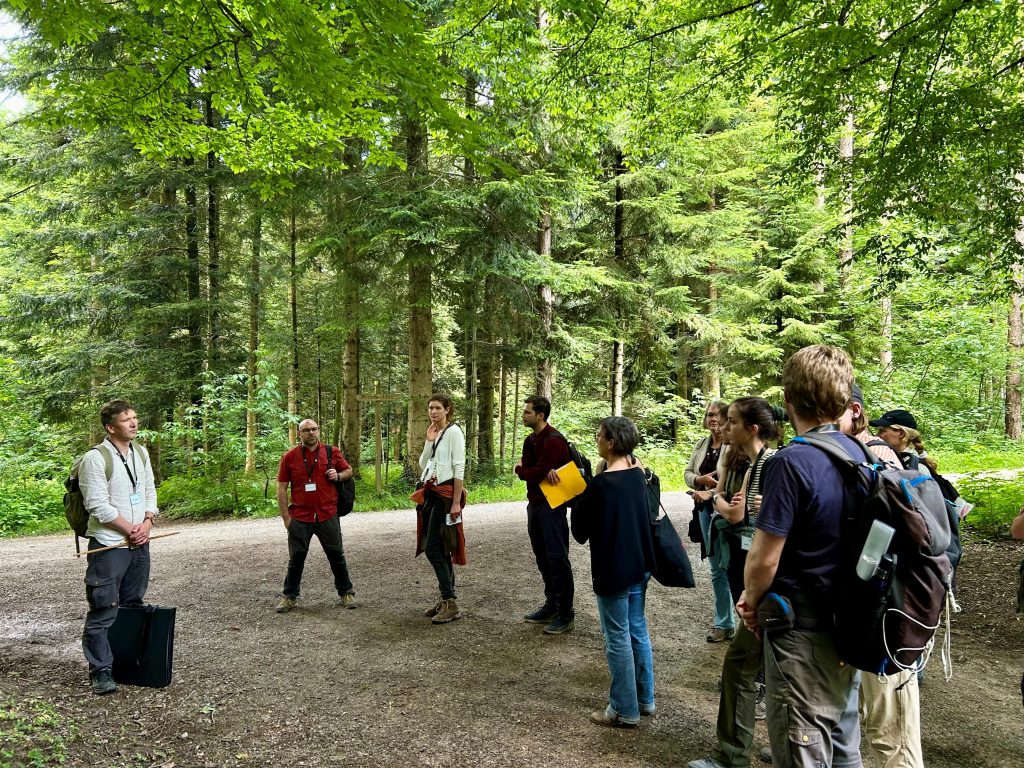
Martin Brüllhardt (left) on an interactive excursion through the “Waldlabor”. Credits: Rahel Könen
In general, the idea is to continuously increase the number of projects hosted at the forest plot and remain open to new ideas from forest managers, researchers and the public.
With the support of volunteers, the Forest Lab also offers guided tours to both experts and lay audiences. An interactive map is accessible in the Waldlabor-App and makes it easy for visitors to explore the forest area on their own.
Towards the end of the tour, Martin Brüllhardt notes that, as a forest plot that connects both forest production and protection, they only ever cut the amount that annually can also regrow. As such, they hope to ensure and showcase the sustainability of wood production.
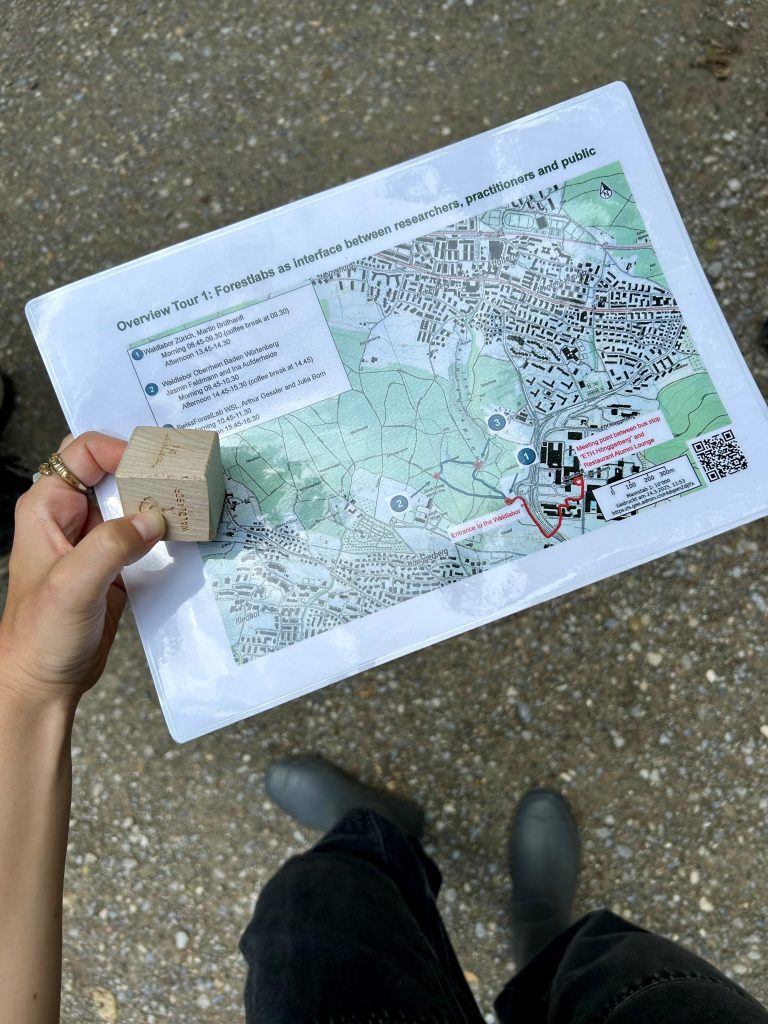
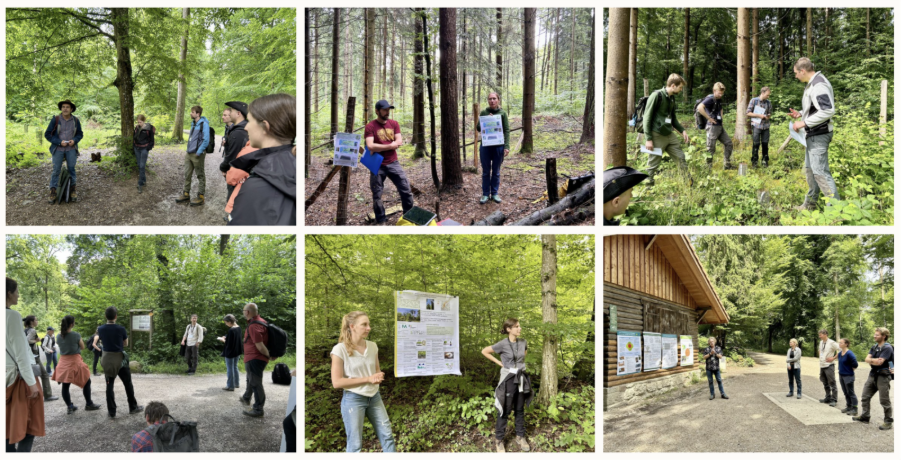
Diverse learning activities that took place at the Waldlabor Zurich as part of our Integrate Network workshop in Switzerland. Credits: Rahel Könen
In the Woziwoda Forest District, northern Poland, forests are managed not only for timber but also as living classrooms. The district combines ecological, social, and protective functions, with a strong focus on education – offering vocational training, outdoor activities, and unique programmes like forest tree beekeeping. This case highlights how multifunctional forests can connect people to nature, biodiversity, and cultural traditions while ensuring sustainable management.
Timber use and ecosystem services, Poland
Case study from How to Balance Forestry and Biodiversity Conservation
Authors for this case study are Stefan Konczal and Agata Konczal.
Article written by Florian Schnabel (University of Freiburg)
I often go running in the hills surrounding Freiburg, Germany. The jogging trails stretch from the Rhine valley to forests that include tall beeches, sun-dappled maples, and towering Douglas firs. On my past run, I came across marked habitat trees – those supporting the diversity of forest-dwelling species through their microhabitats – and just moments later, a stack of freshly harvested Douglas firs – a tree species which, despite not being native, grows well in Europe. This mix of biodiversity conservation and timber production isn’t just a coincidence; it’s a deliberate management choice. And it’s becoming increasingly popular across Europe.
This approach, known as Integrative Forest Management (IFM), is gaining traction in policy circles and on the ground. But despite its popularity, many basic questions remain unanswered: What exactly is IFM? How does it differ from other management concepts? Is it being taught in higher education to the next generation of forest professionals? And is it really delivering its promises to conserve biodiversity while simultaneously sustaining wood production – especially under global change?
These are the questions we’re addressing in Work Package 3 of the EU Horizon ProjectTRANSFORMIT, led by Jürgen Bauhus and myself at the University of Freiburg.
Douglas fir beech close to Freiburg. Credits: Florian Schnabel
A working definition of IFM – and principles for its application
Our first major achievement has been to provide a working definition of IFM for the project:
Integrative forest management (IFM) aims at integrating biodiversity conservation and global change adaptation into forest management for the sustainable provision of multiple ecosystem services… (read the full definition here).
Together with colleagues from ETH Zurich and the Swiss Federal Institute for Forest, Snow and Landscape Research WSL, we thereafter developed a structured framework with eight key principles and accompanying attributes to define what characterises IFM. These principles include retaining habitat structures, promoting native tree species, natural tree regeneration, structural heterogeneity, tree species diversity, low-impact management, landscape connectivity, and management of factors that hinder ecosystem functioning.
Through work led by Valentina Vitali at ETH Zurich, we are in the final stages of reviewing how the IFM concept aligns with other related forest management approaches, such as ProSilva, Closer-to-Nature Forest Management, TRIAD, Continuous Cover Forestry and Strict Set-aside Conservation. Initial results indicate that while all examined concepts show some alignment with IFM principles, they differ in their specific attributes. For instance, Closer-to-Nature Forest Management demonstrates a broader alignment, while TRIAD and Continuous Cover Forestry show a more selective adherence to IFM goals.
What about the next generation? IFM in European higher education.
Through work carried out by Andreea Spinu at the University of Freiburg, we want to understand how IFM is currently incorporated in higher education curricula. This led us to conduct a Europe-wide survey with forest science professors and lecturers. Based on responses from 30 institutions, we found that teaching around IFM tends to prioritize principles that promote natural and site-adapted regeneration, partial harvesting, structural heterogeneity, as well as the retention of habitat trees and deadwood. The responses also highlighted the need for increasing competencies in ecology, resilience, systems thinking, and innovation. Based on this, we identified gaps within current forestry curricula – an analysis that will support the development of a new educational module on IFM under TRANSFORMIT’s Work Package 7. Through these insights we hope to complement and improve the education that shapes a new generation of forest professionals.
Whether it’s at the level of theory or higher education – with our current reviews we aim to offer a clearer picture of what IFM is and how it could be taught in the future. Such an analysis is needed to provide much-needed resources and input to policymakers, educators, and forest managers, aiming to simultaneously ensure timber production, biodiversity conservation, and global change adaptation. They also provide an important conceptual basis for future scientific endeavours – namely, our European-wide analysis of the effectiveness of IFM under various ecological conditions and societal settings. To be able to study a full spectrum of perspectives and contexts, we’ve engaged over 30 IFM-practicing enterprises for this.
So, the next time you walk, run or simply relax in a forest that seems both productive in terms of wood and diverse in species, you may be seeing IFM in action! Thanks to TRANSFORMIT, we’re now one step closer to defining and applying this integrative vision across diverse European forests, as well as ensuring that a next generation of forest enthusiasts knows how to carry it forward.
Dr. Florian Schnabel is a forest scientist at the Faculty of Environment and Natural Resources at the University of Freiburg. His research focuses on the relationships between biodiversity and ecosystem functions of forests, sustainable forest management in the face of global change and the effects of climate extremes on forests. He is leading Work Package 3 entitled Integrative Forest Management in Europe of the TRANSFORMIT project.
Forests are under growing pressure – from climate extremes and invasive pests to rising wood demand and biodiversity loss. In a new article, Prof. Dr. Andreas Rigling (ETH Zurich) explains how integrated forest management can help forests navigate these changes while still providing vital ecosystem services.
Photos: Gesche Schifferdecker. Integrative forest management approaches in Aachen, Germany, and in Horst aan der Maas, Netherlands
Rather than relying on either multifunctional or segregative strategies alone, integrated forest management brings the two together. It supports natural regeneration, encourages structural and species diversity, and provides temporary or permanent protection for certain areas when needed. This balanced approach helps forest managers adapt to different local conditions while meeting ecological, economic, and social needs.
The Horizon Europe project TRANSFORMIT – which is also introduced in the article – is working with Living Labs across Europe to test and co-develop these approaches with forest managers, scientists, policymakers and communities.
The Forest Restoration Talks returned on June 11 with a timely and pressing question: what happens after a severe windstorm in the forest? With storm Éowyn leaving a clear mark on Irish forests in spring 2025 – uprooted trees, fragmented canopies, and policy gaps laid bare – experts and practitioners came together to exchange knowledge on what recovery and restoration should look like.
Hosted in collaboration with the Integrate Network, the TRANSFORMIT project, the SUPERB project, and FoRISK – the Pan-European Forest Risk Facility, the webinar focused on how to respond to extreme disturbance events, strengthen forest resilience, and adapt forestry practices and management for the future.
What happened during Storm Éowyn?
Storm Éowyn was the strongest storm ever recorded in Ireland, with wind speeds topping 184 km/h. The impact was severe: around 26,000 hectares of forest were damaged. Much of the damage occurred in mature conifer stands growing on wet mineral and peat soils. Sitka spruce was by far the most affected species. Forest structure and management history played a clear role in vulnerability – about half of the damaged area had been thinned at least once, raising questions about how timing and intensity of thinning influence resilience. As discussed in the webinar, factors like mixed species, varied age classes, and selective thinning can strengthen forest resilience, though no forest is entirely immune to disturbance.
What can we learn from other countries’ experience?
In North Rhine-Westphalia (NRW), one of Germany’s most forested regions, storms, droughts, and bark beetle outbreaks have left a visible mark. In response, the region developed a comprehensive reforestation strategy focused on resilience. Instead of replanting the same vulnerable species, forests are being rebuilt with a mix of four or more tree species, carefully selected to suit local soil and climate conditions. These “forest development types” also account for different forestry goals – from biodiversity and water retention to recreation and timber production.
Support for forest owners goes beyond written guidelines – which is particularly important because more than half of NRWs forests is privately owned, with many small-scale owners. On-site advice, workshops, and even online courses help owners make informed decisions. A key digital tool, Waldinfo.NRW (in German), offers site-specific guidance, including climate scenario projections and tree suitability maps. This approach puts long-term forest health first – with a focus on climate stability, provision of diverse ecosystem services, and forest vitality.
Policy and the power of networks
One recurring theme was the need for policies that don’t slow down action, but help respond quickly and effectively when disturbances hit. Another important factor highlighted was the role of expert networks and coordinated planning. These networks are essential to ensure that knowledge and lessons learned from past disturbances are not lost between events. Initiatives like the Forest Risk Facility and the Integrate Network are seen as essential platforms to ensure cross-border learning and coordinated action.
Storms like Éowyn expose weaknesses – but also reveal where we can improve. By rethinking planting strategies, improving management transparency, and giving forest owners the tools to both better prevent and respond, the sector can transform storm recovery into long-term resilience. While extreme events may be inevitable, the way we prepare and react is very much in our hands.
Missed the webinar? Watch the full recording here.
If we ask you to think of a healthy forest, you might picture tall, straight trees, green canopies, and neat trails. But some of the most valuable parts of a forest aren’t so perfect – they’re cracked, hollow, decaying, and lying scattered on the ground. These are deadwood and habitat trees – and they’re biodiversity hotspots, providing shelter and food for a wide variety of species that are essential to forest health.
Habitat trees and dead wood offer a large variety of microhabitats supporting biodiversity, and may be threatened by harvesting in managed forests (inspired by Bütler et al. 2020, Humphrey and Bailey 2012). Source: Muys, B. et al. (2022), Forest Biodiversity in Europe, From Science to Policy 13, European Forest Institute, p.34. https://doi.org/10.36333/fs13
Why standing snags and fallen logs matter for ecosystems
Deadwood is far from lifeless. Insects, fungi, mosses, lichens, birds, bats, and small mammals all depend on them at different stages of decay. Some beetle species lay their eggs only in old rotting logs. Mosses and lichens often grow on declining trees and shrubs, as well as on stumps and snags. Deadwood provides a nutrient-rich surface that supports their growth over time.
Fungi are uniquely capable of breaking down lignin – the tough material that gives wood its strength and rigidity. In doing so, they unlock and return long-stored nutrients from the tree back into the soil.
Habitat trees are living or dead standing trees that offer similar benefits. Often old and marked by natural damage, they may have dead branches for some birds to roost and watch for prey, peeling bark, or cavities, where woodpeckers and owls nest. Cracks, crevices, and notches also create vital microhabitats – this is where many other species find shelter, breed, or escape predators. Across the seasons, habitat trees offer plenty to eat – nectar, pollen, fruits, seeds, leaves, and even wood and leaf litter.
How TRANSFORMIT is making space for life
Dead and damaged trees have long been treated as waste – something to be cleared away. But in many managed forests, especially those with short rotation cycles, deadwood and habitat trees are already in short supply. Yet these natural elements are vital for biodiversity, providing food, shelter, and breeding grounds for countless species. This makes their integration a crucial part of sustainable forest management.
With the TRANSFORMIT project, we’re putting this into practice. Here’s how:
In our Living Labs, serving as real-world examples of integrative forest management (IFM), we are implementing practices that balance productive forestry and biodiversity conservation
Creating practical, evidence-based IFM guidelines and indicators to address multiple forest management goals – from biodiversity conservation and resilience to climate change mitigation and community benefits
Showcasing innovative tools such as decision support systems, forest modelling, and interactive digital twins to help improve forest management and decision-making
Running workshops, webinars, and training sessions to spread knowledge and promote IFM practices across Europe and beyond
Dead and decaying trees aren’t forest waste – they are key to keeping forests alive, diverse, and resilient. Leaving them in the forest supports our woodlands to be home to diverse species and cope with increased disturbances, whether from climate change or human activity.
In the wake of Storm Eowyn – which occurred on 24 January 2025, bringing unprecedented wind speeds and widespread disruption across Ireland – forest landscapes have suffered significant damage across the country.
This webinar, organized under the “Forest Restoration Talks” series in collaboration with the European Integrate Network, TRANSFORMIT project and FoRISK facility, brings together forestry professionals, environmental scientists, policymakers, and a landowner to examine the extent and nature of the storm-related damage in Ireland as well as look at other European examples of major forest disturbances.
Together, we’ll explore the immediate impacts, assess longer-term ecological and economic implications, and discuss practices for recovery, resilience planning and climate adaptation measures.
Key Themes and Questions:
How can we better deal with future disturbances across European forests?
How do we transform / adapt our forests to make them more climate resilient?
What can we learn from past experiences to recover and restore forests in an integrative way?
What are current preliminary findings on storm damage across different forest types and regions?
What are strategies to salvage logging, replant and protect biodiversity after storm damage?
How can policy and funding from government and EU support recovery?
– Christophe Orazio from IEFC (Aquitaine, France) brings in knowledge and expertise on forest risk management and climate change adaptation
– Jo O’Hara is a professional Chartered Forester, director of FutureArk Ltd and a non-executive board member of Forestry and Land Scotland. She brings in policy and strategy expertise in relation to change management